Can hybrid organisations transform global coffee value chains?
The global coffee industry is one of the most valuable agricultural sectors in the world, yet it remains deeply unequal. Millions of smallholder farmers produce the raw material, while most of the value is captured far away from origin through trading, roasting, branding, and retail.
This imbalance is not accidental — it is structural. Understanding how it can be changed is central to Wild’s mission and to the future of coffee.
⚠️ New research
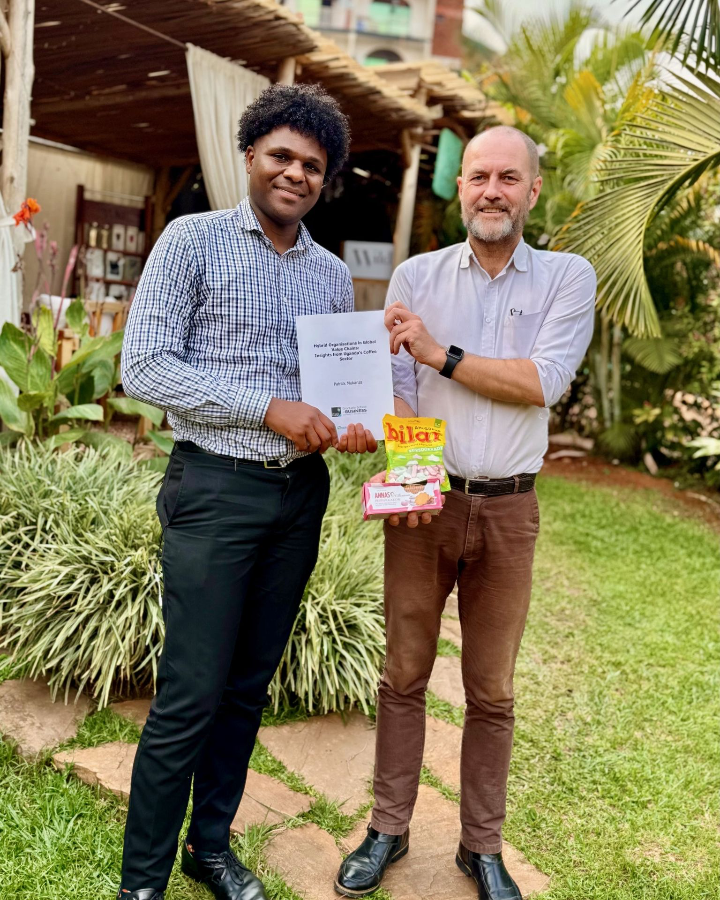
About a year ago our founder Endre Vestvik had the pleasure of being interviewed by Patrick Mukanza for his research into Uganda’s coffee sector.
This is an important topic, and something close to Wild’s mission: the systemic inequalities of the coffee industry.
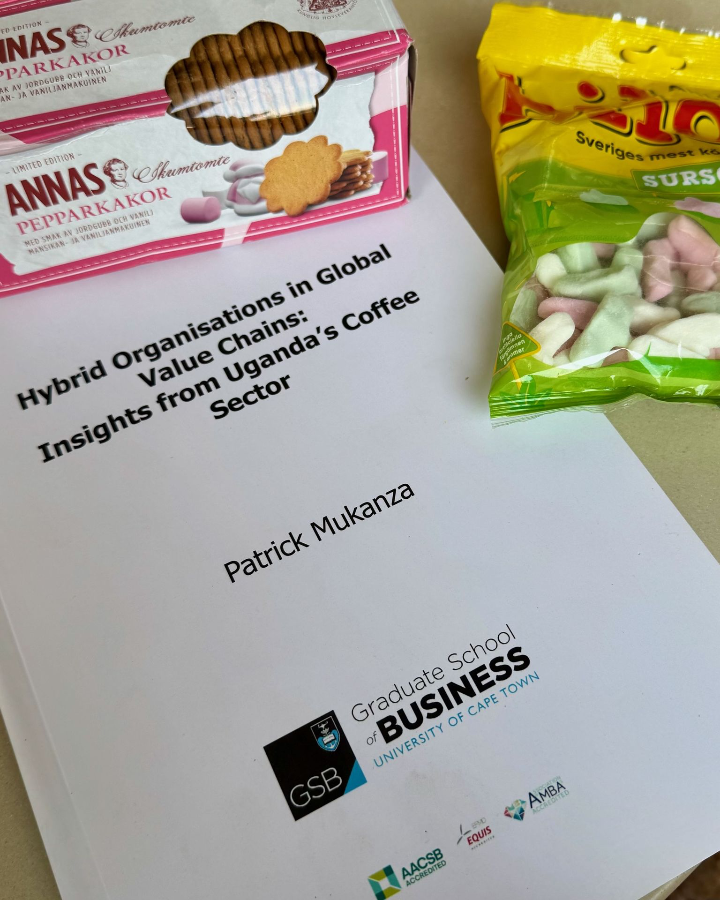
This week Patrick surprised us by showing up with a copy of the results of this work: his PhD dissertation:
Hybrid Organisations in Global Value Chains: Insights from Uganda’s Coffee Sector.
As a bonus Christmas gift he also brought some typical Swedish delights. Such a pleasant surprise. Endre’s young sons will definitely love being introduced to the classic Swedish Bilar!
Why this research matters
Uganda is Africa’s largest coffee exporter and one of the world’s top coffee-producing countries. Yet, like many coffee-producing nations, it captures only a fraction of the final value generated from its coffee. Patrick’s research tackles a critical question: can hybrid organisations — businesses that combine commercial activity with social purpose — help rebalance global coffee value chains?
Below are some of the key findings from his research (direct quotes, except for the emojis):
⚠️ Global value chains (GVCs) represent a core paradox of modern capitalism. While they generate employment opportunities in emerging economies, they also contribute to systemic inequalities, precarious labour, and environmental degradation.
🌍 Africa’s position in international trade has continued to be marginal. As of 2022, the continent accounted for only about 6.5% of global merchandise exports.
🌍 On top of this, the export profile remains heavily dominated by primary commodities with minimal value addition, as reports indicate that the percentage of value added captured in Africa’s export is a mere 14%.
⚠️ This economic pattern, particularly evident in agricultural sectors, means producers receive only a small portion of the final value as processing, branding and retail take place outside the continent.
✳️ Hybrid organisations, those blending commercial and social goals, are increasingly recognized as important actors capable of challenging dominant GVC dynamics by promoting inclusive and sustainable upgrading.
✳️ Empirically, the findings show that hybrid organisations, positioned between smallholder farmers and international traders, contribute to economic upgrading by engaging in functional upgrading strategies such as domestic roasting, direct trade to consumer markets, and moving processing stages closer to origin.
What this means for coffee
The findings confirm what many origin-based coffee businesses have experienced firsthand. Exporting green coffee alone locks producing countries into low-margin roles, while the highest profits are captured elsewhere.
Value addition at origin — roasting, processing, branding, and direct market access — is not a nice-to-have. It is essential for economic justice in coffee.
Hybrid organisations matter because they operate in the space between charity and extractive commerce. They are commercially viable, but purpose-driven.
In coffee, this means:
- Working directly with smallholder farmers
- Paying prices that reflect real value, not commodity minimums
- Investing in local processing and roasting infrastructure
- Creating skilled jobs at origin
- Building direct trade relationships with consumer markets
This is how economic upgrading happens in practice — not through slogans, but through structural shifts in who does the work and who captures the value.
Why this aligns with Wild’s mission
At Wild, we believe the coffee industry was built on colonial extraction and remains structurally unfair.
Fair trade and certifications have helped, but they have not changed the system at its core.
Patrick’s research reinforces our conviction that systemic change requires new organisational models, not incremental fixes.
We hope Wild can be one of those organisations helping to build a more fair and just coffee value chain — one where producing countries are not just suppliers of raw materials, but owners of processing, brands, and narratives.
Thank you so much for doing this important work, Patrick. We look forward to diving deeper into your findings and continuing the conversation around coffee justice, hybrid business models, and sustainable value chains.
🚀 This is the future of coffee:
🔥 No more export of raw materials! All coffee roasted at source!
Because the future of coffee should be built where coffee grows.
Do you want to join our mission? Reach out!