When is coffee harvested in 🇺🇬 Uganda?

Uganda lies almost exactly on the Equator, giving it a bimodal rainfall pattern — a long rainy season (March–May) and a short rainy season (October–November). Coffee cherries ripen roughly 8–9 months after flowering, which follows the rains.
Because each of the four Arabica regions sits in a different position relative to those rainfall bands — and at different altitudes — they don’t all harvest at the same time. This is actually what makes Uganda unique: Arabica is available almost year-round when you look across all four regions together.
This calendar shows the main harvest and "fly crop" of the four main Arabica regions of Uganda.
Uganda Arabica Harvest Calendar
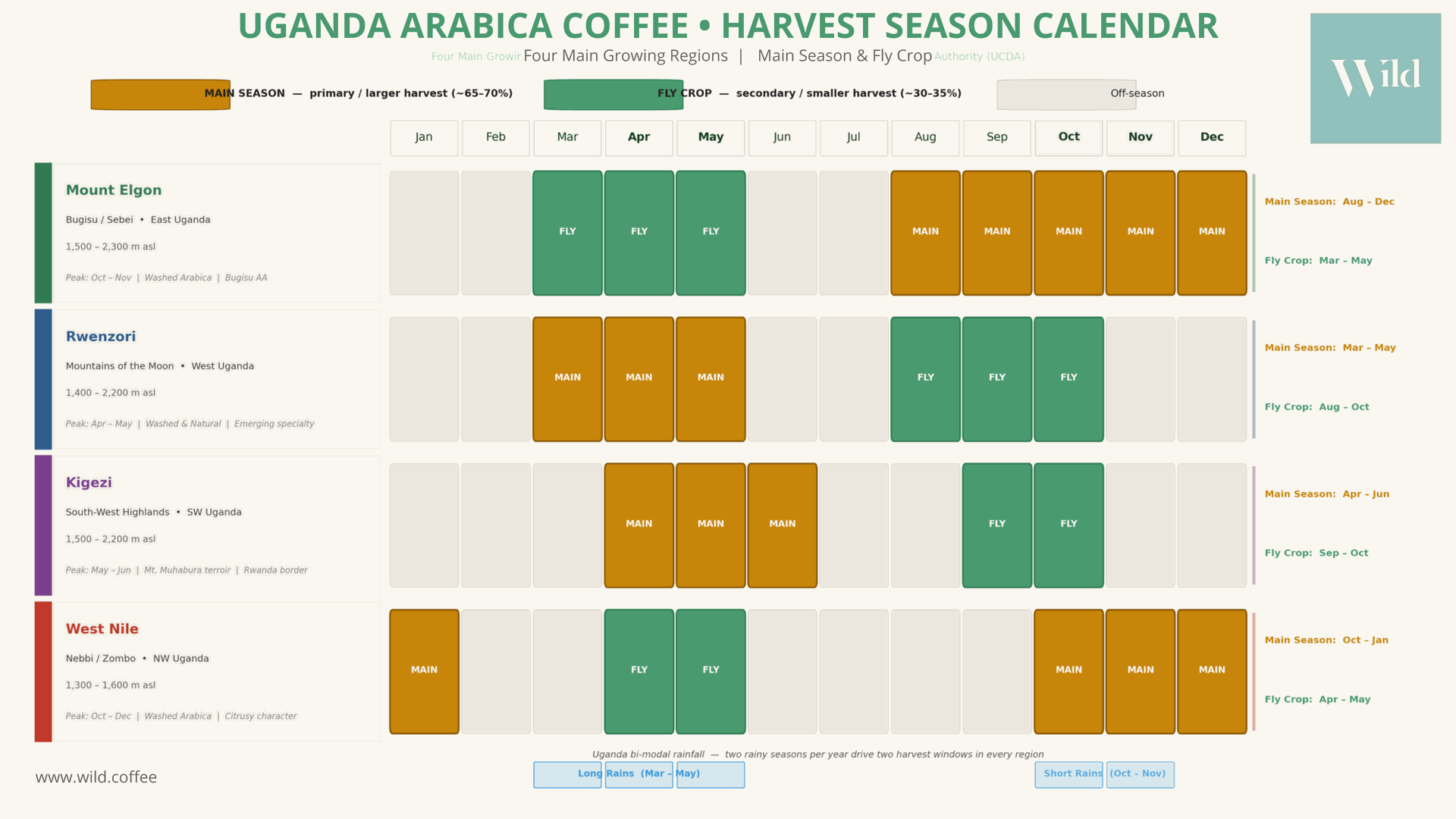
Region-by-Region Breakdown
Mount Elgon (Bugisu / Sebei) — East Uganda | 1,500–2,300 m
Uganda’s most celebrated Arabica region, home to the famous Bugisu AA washed coffees. The volcanic slopes, high altitude and the east-facing aspect give it an extended dry period before harvest, producing the intense sweetness and citric brightness Bugisu is known for.
| Season | Months | Notes |
|---|---|---|
| Main Season | Aug – Dec | Peak Oct–Nov. Accounts for ~65–70% of annual output |
| Fly Crop | Mar – May | Peak Apr–May. Lighter volume but often good quality |
Source: UCDA Country Coffee Profile
Rwenzori (‘Mountains of the Moon’) — West Uganda | 1,400–2,200 m
Stretching 120 km along the DRC border, the Rwenzori range has its harvest cycle inverted relative to Mount Elgon because the long rains hit the west first. This region is an emerging specialty powerhouse, producing both washed and natural Arabicas with floral and tropical fruit profiles.
| Season | Months | Notes |
|---|---|---|
| Main Season | Mar – May | Peak Apr–May. Follows the long rains |
| Fly Crop | Aug – Oct | Peak Aug–Sep. Follows the short rains |
Source: UCDA Country Coffee Profile | Darley Investments
Kigezi (South-West Highlands) — SW Uganda | 1,500–2,200 m
Kigezi sits in the highlands bordering Rwanda and DRC, home to the iconic Mt. Muhabura in Kisoro District. Being in the same western-equatorial bloc as the Rwenzori, its harvest pattern broadly follows the western calendar — but shifts slightly later because of its more southerly latitude and microclimate, pushing the main season into April–June.
| Season | Months | Notes |
|---|---|---|
| Main Season | Apr – Jun | Peak May–Jun. Richly volcanic terroir |
| Fly Crop | Sep – Oct | Lighter secondary season |
Source: UCDA Country Coffee Profile | Genuine Origin Uganda Report 2024
West Nile (Nebbi / Zombo) — NW Uganda | 1,300–1,600 m
The most remote of Uganda’s Arabica regions, growing under the shade of indigenous banyan trees near the DRC and South Sudan borders. West Nile Arabica is almost exclusively washed-processed, known for its clean, citrusy and tea-like character at a slightly lower altitude than the other three regions.
| Season | Months | Notes |
|---|---|---|
| Main Season | Oct – Jan | Peak Oct–Dec. Follows the short rains |
| Fly Crop | Apr – May | Short secondary season |
Source: UCDA Country Coffee Profile
Key Observations
1. The east and west are mirror images. Mount Elgon’s main season (Aug–Dec) is almost the exact opposite of Rwenzori’s main season (Mar–May). Uganda’s Arabica origins are therefore naturally counter-seasonal to each other.
2. West Nile aligns with the east. Despite being in the northwest, West Nile’s rainfall pattern tracks the eastern dry/wet cycle, giving it an Oct–Jan main season very similar to Mount Elgon.
3. Kigezi lags Rwenzori by about 4–6 weeks. Being further south and at higher elevation, cherry ripening is slightly delayed, pushing the peak toward May–June.
4. Uganda offers Arabica nearly year-round. If you source across all four regions there are only two genuine “gaps” — January/February (between West Nile main season ending and the western regions starting) and July/August (mid-year lull before Mount Elgon and West Nile start again).
5. “Fly crop” terminology. In Uganda’s official UCDA documentation, the fly crop is always the smaller, secondary harvest. Some private exporters on Mount Elgon use the term “fly crop” locally for what is actually their larger Oct–Feb harvest — which can cause confusion in sourcing conversations.